
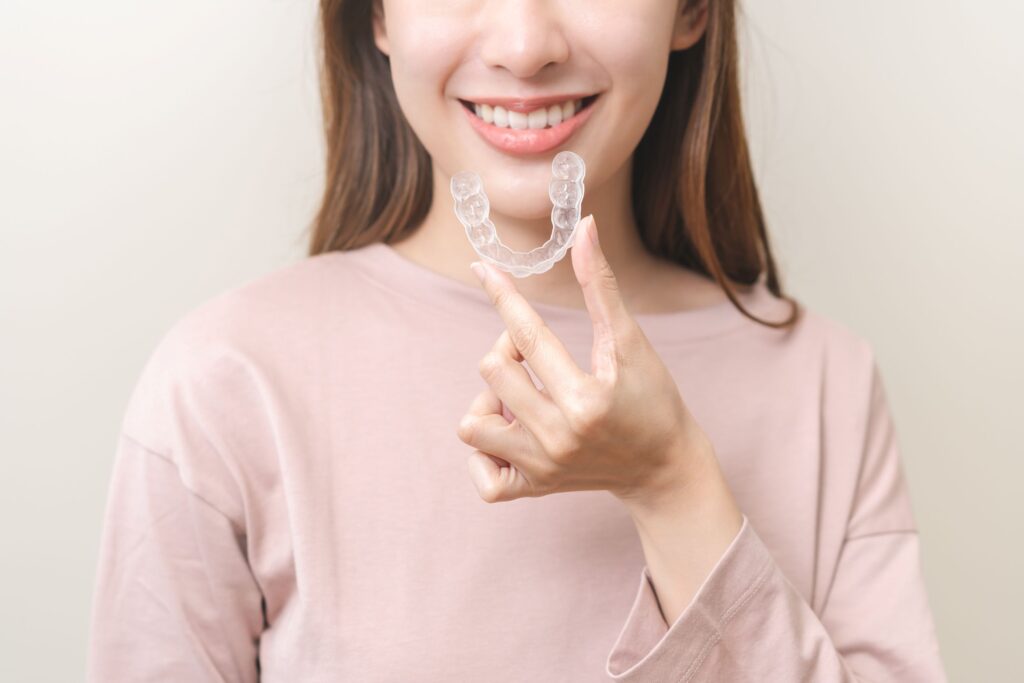
You’re not alone if you’re feeling frustrated with or self-conscious about gapped, overcrowded, or crooked teeth. Sources estimate that, in 2025, nearly 2.6 million Invisalign cases were shipped globally, and that over 22 million U.S. Americans have undergone this treatment.
These transparent plastic trays continue to gain popularity as a more discreet and comfortable alternative to traditional braces, but it’s important to be well-informed before deciding to proceed. Continue reading to learn 3 things you should know about Invisalign before scheduling a consultation with your dentist!
Truth #1: You Might Feel Sore
One reason so many patients choose clear aligners over standard orthodontics is that they are considered more comfortable. For example, the smooth plastic material is unlikely to cut or gouge the tender tissues inside your mouth like bulky metal brackets and clipped wires tend to do.
But it’s important to remember that any service that exerts enough pressure over your teeth to shift them has the potential to hurt, and Invisalign is no exception. It’s normal to feel achy for a few days after inserting new trays. Fortunately, this discomfort usually resolves on its own and can often be reduced with over-the-counter pain medications and sticking to soft foods until your mouth adjusts.
Truth #2: You Could Develop a Temporary Lisp
These clear trays are designed from digital impressions of your mouth, so they fit like a glove to shift your teeth and can work as intended. Even though the material isn’t considered bulky or awkward, it might still take your tongue and the other tissues in your mouth time to acclimate to the presence of your new trays.
Some patients develop short-term changes to their speech patterns, such as a lisp or a slight slur, during this transition period. It typically fades after a little while, though you can speed up the process by reading aloud or recording yourself speaking, so you can pinpoint challenging words or sounds and rehearse them until you feel more confident in your enunciation.
Truth #3: Your Treatment May Require Attachments
Historically, Invisalign was offered to patients with milder misalignments, while braces were often required for more severe issues and malocclusions. But that’s no longer always the case today! Thanks to invisible attachments, or buttons, many dentists can use these clear trays to address more complex concerns than before.
To do so, they’ll create small lumps on your teeth using clear or tooth-colored composite resin, which serves as an additional anchor for the transparent trays. This improves their grip, allowing them to move teeth over greater distances or with more force. Then, they can be easily and painlessly removed after treatment is completed.
If you are still unsure whether Invisalign is right for you, you can learn more by contacting your dentist for a consultation!
Meet the Author
Dr. Ernesto Ulloa takes pride in helping improve his patients’ lives by providing customized services to meet their unique dental needs. He earned his dental degree from the University of Medical Sciences at Villa Clara, then received a second advanced degree from the Boston University Henry M. Goldman School of Dental Medicine. Today, he offers a complete menu of services, including Invisalign, to help people of all ages build and maintain beautiful, healthy smiles. You can request an appointment on the website or by calling (919) 220-4200.